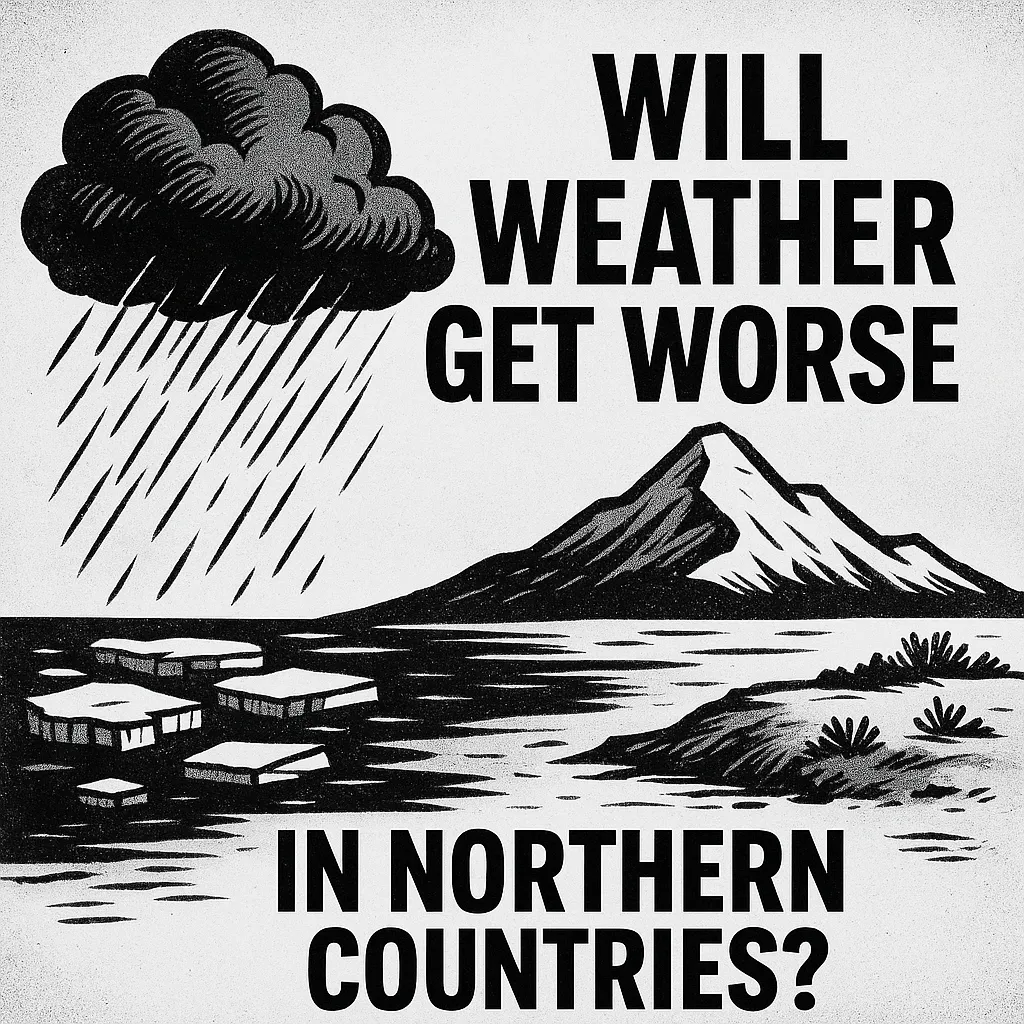
Will Weather Get Worse in Northern Countries? What the Climate Science Says
The Far North is warming faster than the rest of the world. Regional climate models point to more extreme weather, melting permafrost, shifting precipitation, and serious infrastructure risks. Here's how severe it could become and how communities can adapt.
1. Why Northern Regions Are Especially Vulnerable
🔥 Arctic Amplification
Northern latitudes are warming at a rate far above the global average — a phenomenon called Arctic amplification. (World Meteorological Organization)
The Arctic is expected to warm three times or more faster than lower latitudes over the coming years. (ArcticToday)
🧊 Permafrost Thaw & Melting Ice
Much of the land in high-latitude northern regions is underlain by permafrost. As temperatures rise, this permafrost thaws, leading to ground subsidence, erosion, unstable infrastructure, and the release of greenhouse gases like methane. (IPCC)
Glaciers and sea ice are shrinking, reducing reflective ice surfaces (albedo), which further accelerates warming. (npolar.no)
🌧 Changing Precipitation & Wetter Winters
Northern regions are projected to see more precipitation, especially in winter and autumn, though more of it may fall as rain rather than snow in some locales. (npolar.no)
Some regional models foresee annual precipitation increases of 20–40% in portions of the Arctic by mid-century. (npolar.no)
🔄 Feedback Loops & Extreme Events
As ice melts and land surfaces darken, more solar heat is absorbed, accelerating warming (positive feedback).
Additionally, thawing soils and changing hydrology may lead to more forest fires, shifting vegetation zones, and stronger storms. (IPCC)
2. What Projections & Models Tell Us: Weather in the North by 2030–2050
Here’s what climate models and scientific assessments suggest may happen in northern countries over the next few decades.
| Change | Likely Outcome | Risk / Impact |
|---|---|---|
| Higher mean temperatures | Northern regions may see average temperature rises of 1–3 °C or more depending on location and emissions scenario. (Wikipedia) | Milder winters, heat stress for infrastructure, species stress |
| Warmer winters, shorter snow seasons | Snow cover may become less stable, with more rain events during what used to be cold months. (npolar.no) | Flooding, freeze-thaw damage, changes to ecosystems |
| More extreme precipitation & storms | Larger storm events, heavier rain, more variable patterns. (npolar.no) | Flooding, erosion, strain on drainage & infrastructure |
| Permafrost and ground collapse | Up to 70% of Arctic infrastructure lies in zones threatened by permafrost thaw. (IPCC) | Roads, pipelines, buildings, utility lines at risk |
| Possibility of abrupt cooling in some regions | If Atlantic currents (like AMOC) weaken significantly, some parts of northern Europe might see colder winters despite overall warming. (Carbon Brief) | Disruptions in weather norms, conflicting trends |
| Extreme heat & new heat records | Northern nations are already experiencing anomalous heatwaves (e.g. in Nordic regions). (The Guardian) | Stress on health systems, local ecosystems |
3. Are Some Northern Countries Better Off?
Interestingly, some high-latitude nations might see short-term benefits in certain sectors:
- Longer growing seasons could allow for new agricultural opportunities in northern regions. (Wikipedia)
- Reduced heating costs in milder winters might save energy in northern communities.
- New shipping & resource access as sea ice retreats may open Arctic passages and resource zones.
But these “benefits” often come with trade-offs — habitat loss, increased vulnerability to storms, permafrost damage, and social disruption.
4. Challenges & Uncertainties
- Regional variation is huge: Northern Canada, Scandinavia, Siberia, Greenland — each will face distinct changes.
- Tipping points & ocean circulation: Weakening ocean currents (e.g. AMOC) might cause abrupt cooling in pockets, complicating projections. (Carbon Brief)
- Emission pathway dependence: Future outcomes hinge heavily on whether global emissions are curtailed or continue to rise.
- Adaptation capacity varies: Some northern nations/cities have more infrastructure and resilience planning; remote communities may struggle.
5. What Northern Countries Should Do to Prepare
- Assess & reinforce infrastructure
Build roads, buildings, bridges to tolerate thaw, shifting soil, and flooding. - Monitor permafrost & ground stability
Use sensors and mapping to detect early signs of collapse or subsidence. - Adapt water & drainage systems
Update capacity to handle heavy rainfall and changed snowmelt timing. - Land use planning & zoning
Avoid building on thaw-prone ground; account for shifting ecosystems and wildfire risk. - Ecosystem resilience & biodiversity strategies
Protect species, anticipate range shifts, and preserve refugia (stable habitats). - Community engagement, especially Indigenous knowledge
Leverage traditional ecological knowledge with science in adaptation plans. - Climate mitigation & emissions reductions
Northern countries must also contribute to global efforts to slow warming and avoid worst-case outcomes.
✅ Conclusion: Yes, Northern Countries Are Likely to See “Worse” Weather — But It’s Complicated
The data make it clear: northern nations face disproportionate risks from climate change. Winters will warm, extremes will intensify, permafrost will destabilize, and rain/snow patterns will shift. But not everything is simple — in some areas, certain benefits may briefly emerge, and non-linear factors like ocean currents could introduce unexpected twists.
In short: for northern countries, climate change doesn’t only mean “worse” weather — it means a fundamentally different weather regime, with new hazards, opportunities, and adaptation challenges.